

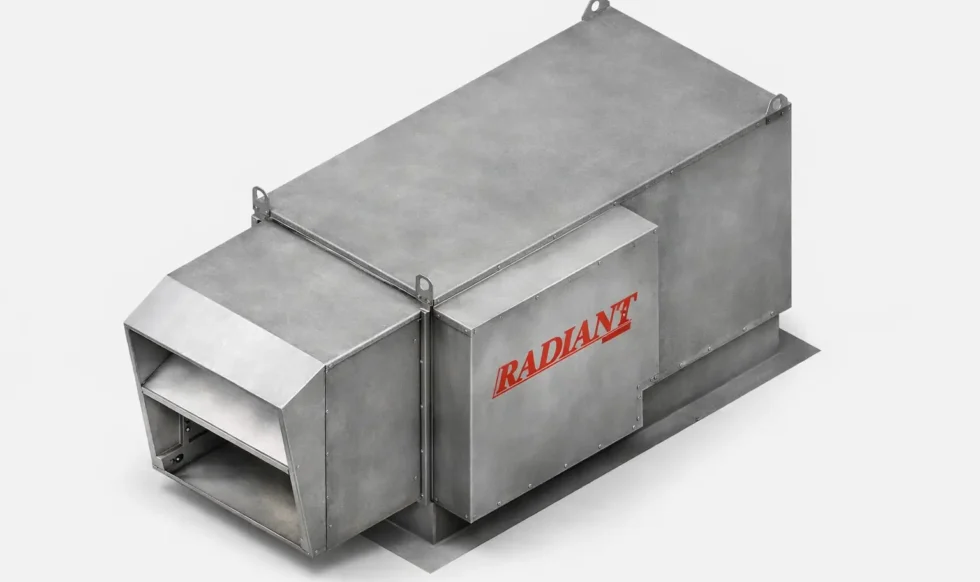
Heating Equipment
Makeup Air Units (AMUs) are engineered to supply a controlled volume of clean, filtered, and heated replacement air to spray booths and industrial facilities, helping maintain balanced airflow, stable booth pressure, and consistent temperature performance throughout the finishing process. By using advanced digital sensors and precision control systems, AMUs continuously monitor and regulate tempered air to minimize temperature stratification and reduce fluctuations that can impact coating application, flash times, and overall finish quality. This controlled air delivery supports improved operational efficiency, more uniform curing conditions, and a cleaner, more reliable production environment. Available in both direct-fire and electric configurations, our AMUs can be tailored to meet the performance requirements, energy demands, and application needs of a wide range of finishing systems.
Why Air Makeup Matters
A spray booth exhausts a large volume of air, and that air has to be replaced. If it is not replaced deliberately, the booth pulls it in through every gap in the building — door seams, dock doors, wall penetrations — bringing unfiltered, unconditioned air straight into the space you are trying to keep clean.
An air makeup unit supplies filtered, temperature-controlled replacement air at a matched volume. That keeps the booth at its intended pressure and the incoming air at a workable temperature, which is what makes consistent finish quality possible in the first place.
Direct-Fired and Indirect-Fired Systems
- Direct-fired — the burner flame sits directly in the airstream. Highly efficient, since nearly all the heat transfers into the air, and typically lower in cost. Combustion products enter the supply air, which suits many industrial applications but not every coating or process.
- Indirect-fired — combustion happens inside a heat exchanger and vents separately, so supply air stays free of combustion byproducts. Lower thermal efficiency and higher cost, but necessary where the process or product demands clean air.
Temperature Control and Cure Cycles
Modulating burner control holds supply temperature within a narrow band rather than cycling between over and under target. That matters for two reasons. Coating manufacturers specify application temperature ranges deliberately, and cure schedules assume the part actually reaches and holds temperature rather than simply getting warm.
Digital sensors paired with a properly programmed control panel are what separate a system that hits spec from one that only approximates it.